
INJARO CONSULTING | OFFICIAL DECONSTRUCTED PILOT CASE STUDY
Deconstructing Real-World Incidents Through Predictive Risk Intelligence
From Retrospective Investigation to Real-Time Prevention.

Explore the interactive case studies below to see predictive risk intelligence in action.
Our Deconstructed Pilot Case Study
Pilot Case Study 1
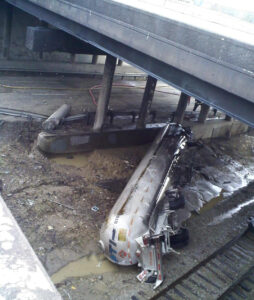
Cargo Tank Overturn & Fire Deconstruction: Re-Analyzing NTSB HAR-11-01
Translating Retrospective Official Investigation Findings into a Proactive Human • System • Asset (HSA™) Predictive Defense Engine.
Executive Summary Paragraph:
Conventional safety management systems evaluate incidents after loss of life and capital damage have occurred. This case study deconstructs the official National Transportation Safety Board (NTSB) report on the catastrophic hazardous materials overturn and fire in Indianapolis. By cross-validating telemetry anomalies, driver cognitive drift, and procedural verification shortcuts, we illustrate how the HSA™ Engine isolates latent risk patterns and executes preventative command actions long before critical thresholds are breached.
Official Incident Detail
Accident / Investigation Title: Rollover of a Truck-Tractor and Cargo Tank Semitrailer Carrying Liquefied Petroleum Gas and Subsequent Fire
Official Report Reference: NTSB Highway Accident Report HAR-11-01
Accident Identifier: HWY10MH001
Date of Event: October 22, 2009
Actual Impact: Multiple Fatalities, Highway Infrastructure Damage, Hazardous Spill Lockdown[cite: 1, 5, 7].
Official NTSB PDF Report: Download Official NTSB HAR-11-01 Report (PDF)
Official NTSB Case & Recommendation Page: Access NTSB Safety Recommendation Record HWY10MH001
The Illusion of Compliance: Decoupled Systems in High-Consequence Operations
The official NTSB investigation revealed multiple systemic gaps where individual safety checkpoints operated in strict silos. While traditional paperwork and basic GPS telemetry marked the trip as "Compliant," the underlying operational reality was rapidly deteriorating. Standard audits cannot catch micro-variations in driver fatigue or real-time dynamic cargo displacement.
Unmonitored Cognitive Drift
(Human Blindspot)
NTSB Finding: Pre-trip inspection records indicated standard clearance. However, procedural timestamp analysis showed expedited completion times (fast-clearance), bypassing rigorous physical verification.
Paper Compliance & Fast Clearance
(System Blindspot)
NTSB Finding: Pre-trip inspection records indicated standard clearance. However, procedural timestamp analysis showed expedited completion times (fast-clearance), bypassing rigorous physical verification.
Siloed Telemetry & Center of Gravity Shifts
(Asset Blindspot)
NTSB Finding: Pre-trip inspection records indicated standard clearance. However, procedural timestamp analysis showed expedited completion times (fast-clearance), bypassing rigorous physical verification.
HSA™ Data Blending Matrix: Cross-Validating Retrospective Data
How the HSA™ Engine connects Human, System, and Asset data threads to detect high-risk operational anomalies.
HSA™ Pillar
Retrospective NTSB Investigation Finding
HSA™ Real-Time Predictive Engine Intervention
HUMAN (H)
Driver fatigue and delayed steering reaction upon entering the curved connector ramp.
CoCo Cycle Analytics: Tracks micro-steering delays and cognitive fatigue markers, flagging high-risk drift prior to curve entry.
SYSTEM (S)
Pre-trip digital checklists marked "Passed" without physical duration verification.
Timestamp & Geofence Verification: Automatically flags "System Slippage" and restricts dispatch authorization.
ASSET (A)
Liquid slosh dynamics shifted Center of Gravity beyond lateral stability limits.
Sensor Fusion: Blends real-time liquid cargo stability data with GPS ramp geometry to enforce dynamic speed thresholds.
The Tactical Command Output
Predictive Intervention Logic in Action
How the HsA Engine Stops High-Fatality Incidents Before They Happen
What the Engine Detects in Real-Time
The HsA Engine continuously cross-validates three critical risk markers:
Human
Driver Fatigue
Cabin cameras and telemetry register micro-sleep events and delayed steering responses.
System:
Rushed Compliance
The pre-trip checklist was completed too quickly (fast-clearance), indicating a superficial inspection.
Asset:
Vehicle Instability
Sensors detect dangerous cargo slosh dynamics and lateral instability while approaching a curve.
What the Engine Automatically Executes
Instead of merely logging the data, the HsA Engine immediately triggers an automated, three-tier response:
In-Cabin Alert
Deploys an audio-visual warning inside the cab to snap the driver back to full situational awareness.
Automatic ECU Restriction
Restricts vehicle engine speed (capped at 30 km/h) before entering the high-risk downhill curve.
Mandatory Fleet Intervention
Escalates an urgent command to the Control Room to enforce a mandatory rest stop at the nearest emergency bay.
Auto Executed
Deconstruct Your Incidents with HSA™
Put Your Past Incident Report to the HSA™ Test
Re-evaluate an unresolved, recurring, or complex past incident using our multi-pillar data-blending framework to uncover critical operational blind spots.
The Value Proposition & Criteria Checklist
Most post-accident investigations rely on isolated post-mortem audits that attribute root causes to simple human error or isolated mechanical faults.
We invite you to submit an official incident report from your operations. Our lead analysts will run your chronological data through the HSA™ (Human • System • Asset) Data Blending Engine to reconstruct the event, revealing how unseen cross-pillar vulnerabilities directly led to the breakdown.
What You Will Receive (No-Cost Benchmark Assessment)
HSA™ Incident Reconstruction Map:
A visual timeline matching human fatigue/behavioral indicators, system compliance timestamps, and mechanical sensor data.
Blind Spot Breakdown:
Identification of weak signals and procedural drift that conventional audits missed.
Autonomous Logic Protocol:
A tailored example of real-time intervention logic that would have prevented the incident.
To ensure a high-precision HSA™ analysis, your uploaded report should meet the following minimum criteria:
[✓] Official Investigation Format: Complete incident/accident report with a clear chronological timeline.
[✓] Multi-Layered Context: Contains operational details spanning human actions/shifts, procedural/SOP steps, and asset/equipment status.
[✓] Redacted/Anonymized: Sensitive data (personal names, specific locations, or asset IDs) may be anonymized or redacted prior to submission.
[✓] Supported Sectors: High-hazard operations (Fuel/Hazmat Transportation, Process Safety, Mining, Marine, Heavy Equipment).
Deconstruct Your Incident Report
Prevent Your Next Incident Before It Becomes an Investigation
Don't wait for post-accident reports to uncover your operational blindspots. Schedule an executive briefing to see how the HSA™ Engine protects your fleet, assets, and reputation.
Discuss an HSA Pilot With Us