INJARO CONSULTING | HSA™ IN PRACTICE
From Operational Events to Operational Intelligence
Real operations rarely fail for a single reason.
Conditions across people, processes, equipment, information and decision-making can interact in ways that are difficult to see through isolated observations or conventional reporting.
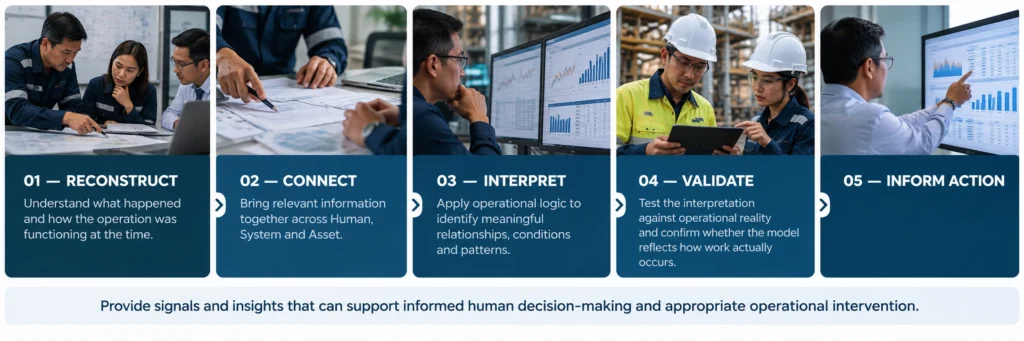
These applied case studies demonstrate how the HSA™ Human • System • Asset framework can be used to examine complex operational conditions, connect fragmented information, and develop a more structured understanding of what may be happening across an operation.

Explore the interactive case studies below to see predictive risk intelligence in action.
Applied Case Studies
01 - Case Study:
Rollover of a Truck-Tractor and Cargo Tank Semitrailer Carrying Liquefied Petroleum Gas and Subsequent Fire
A practical application of HSA™ to examine how operational conditions across Human, System and Asset can interact and contribute to an operational event.
Focus: Human • System • Asset
Explore the Case Study 0102 - Case Study:
Reboiler Rupture and Fire
A second application demonstrating how HSA™ can connect operational information, process conditions and control requirements to reveal relationships that may otherwise remain difficult to see.
Focus: Human • System • Asset
Explore the Case Study 02What These Cases Demonstrate
HSA™ looks beyond isolated events.
An operational event is rarely defined by one factor alone. HSA™ examines the relationships between three interconnected dimensions:
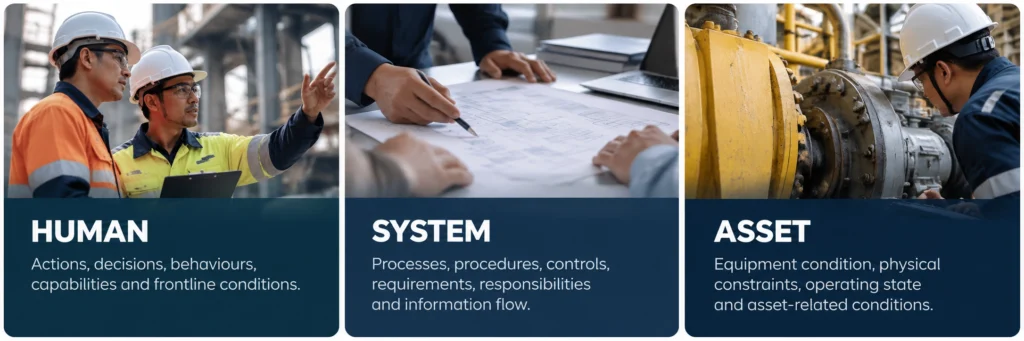
Together, these dimensions provide a structured basis for understanding how operational conditions develop and interact.
The objective is not simply to assign a single cause, but to understand the conditions and relationships that shape operational reality.
From Information to Operational Intelligence
Operational organizations already generate large amounts of information.
The challenge is connecting that information to how the operation actually works.
HSA™ provides a structured pathway for transforming operational information into intelligence that can support human decision-making.
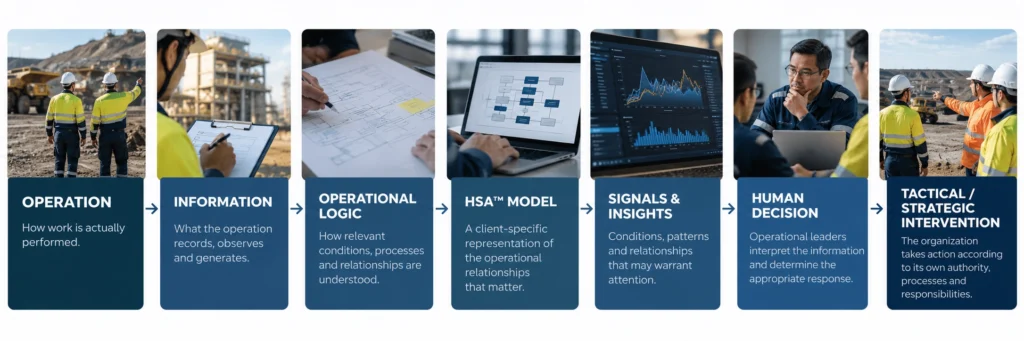
How HSA™ Is Applied
HSA™ is not applied as a generic analytical template.
The framework is developed around the client's actual operation, available information and operational logic.