INJARO CONSULTING | APPLIED CASE STUDY 01
Applied Case Study 01
An applied INJARO analysis of a high-consequence cargo-tank rollover, based on the official investigation by the U.S. National Transportation Safety Board.
Source:
U.S. National Transportation Safety Board
Highway Accident Report HAR-11/01
Incident:
Rollover of a Truck-Tractor and Cargo Tank Semitrailer Carrying Liquefied Petroleum Gas and Subsequent Fire
Location:
Indianapolis, Indiana
Date:
October 22, 2009
The Incident
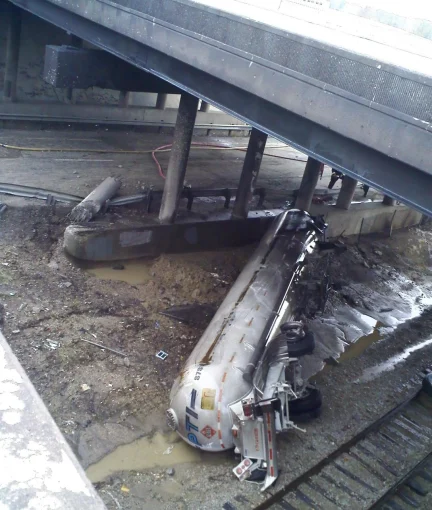
On October 22, 2009, a truck-tractor and cargo-tank semitrailer carrying approximately 9,001 gallons of liquefied petroleum gas rolled over on a connection ramp between I-69 and I-465 in Indianapolis, Indiana.
The vehicle had entered a left curve when it began to encroach upon an occupied lane. The driver responded with an evasive steering maneuver, sending the combination unit onto the right shoulder and then back toward the roadway.
The cargo tank subsequently rolled over, struck a bridge pier, and was breached. The released liquefied petroleum gas formed a vapor cloud and ignited.
The truck driver and the driver of the passenger vehicle sustained serious injuries. Three occupants of passenger vehicles on I-465 sustained minor injuries in the post-accident fire.
What the Investigation Established
The NTSB investigation examined the event across driver performance, motor carrier operations, vehicle and cargo-tank characteristics, roadway conditions, and the consequences of the collision.
Human Response
The driver's excessive, rapid, evasive steering maneuver triggered the subsequent accident sequence.
Vehicle & Load
The combination unit had a high center of gravity, and the cargo tank was approximately 78 percent full. NTSB identified the characteristics of the vehicle and partial liquid load as relevant to rollover stability.
Roadway
The transition from the travel lane to the paved shoulder reduced the effective rollover tolerance of the combination unit.
Operational Information
Investigators compared handwritten hours-of-service records with shipping documents and vehicle-position history from the Qualcomm tracking system. That review identified discrepancies, including false log entries and hours-of-service violations on three days in October 2009.
The findings above are drawn from the official investigation. The analysis that follows is INJARO's application of its current operational framework.
The Incident Was Not a Single-Point Failure
The NTSB identified a specific probable cause. But the development of the event involved more than the final steering action alone.
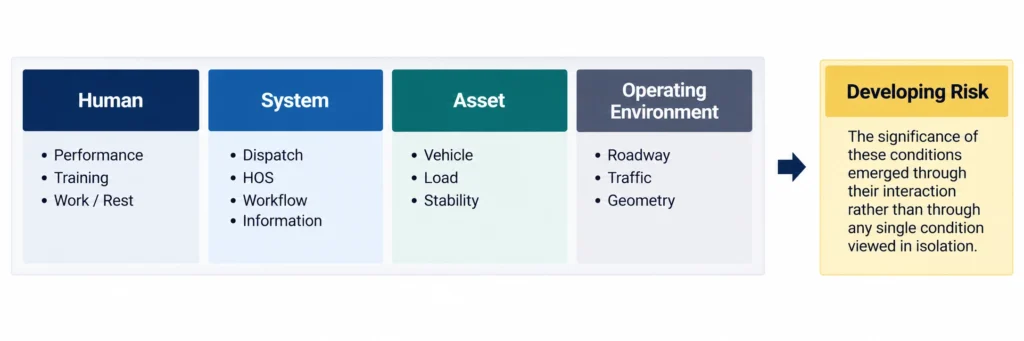
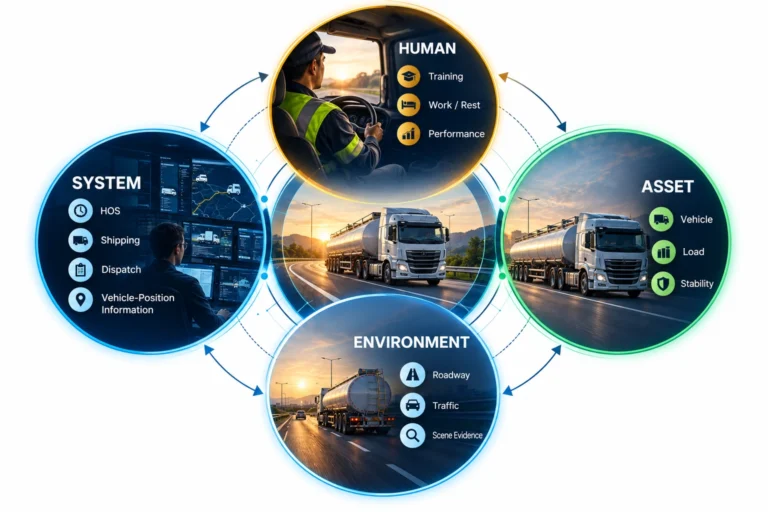
Human response occurred within an operating system, involving training, work and rest patterns, dispatch and delivery activities, information records, vehicle characteristics, load condition, and roadway geometry.
These conditions interacted.
Human Performance Under Changing Conditions
This creates an important operational question:
Does training translate into appropriate performance when conditions change?
For INJARO, the question is not simply whether training was delivered.
It is whether capability can be recognized, strengthened, supported, and applied under real operating conditions.
Relevant INJARO service:
Frontline Performance & Intervention
Feature: Strengthening the connection between capability, field performance, intervention, follow-through, and learning.
The Operation Around the Driver
Frontline performance does not occur in isolation.
The operational question:
Where should critical information be captured, verified, connected, interpreted, and escalated?
This is not simply a compliance question.
It is an operational-control question.
A Sound Asset Can Still Have Low Risk Tolerance
The operational question:
How does asset vulnerability change when operating conditions change?
A mechanically sound asset can still become operationally vulnerable.
Risk Changes With the Environment
The operational principle
Risk is contextual.
Human performance, asset characteristics, and environmental conditions need to be understood in relation to one another.
From Conditions to Consequence
The event developed through a sequence of interacting conditions:
Operating conditions
Lane encroach
ment
Rapid evasive steering
Shoulder transition
Reduced rollover tolerance
Rollover
Tank impact
LPG release and fire
The NTSB identified the driver's excessive, rapid, evasive steering maneuver as the probable cause, with the return from the shoulder, reduced shoulder cross-slope, and the combination unit's high center of gravity contributing to the rollover.
Information Across the Operation
Understanding the event required information from different operational contexts.
The value is not simply in having more information.
It is in understanding what the information means in context and in relation to other conditions.
This is a title
Applying the INJARO Approach
The following is an applied examination using INJARO's current methodology.
It is not a claim that INJARO investigated or intervened in the historical event.
Operational Risk Diagnostic
What conditions increased exposure, vulnerability, or consequence potential?
Human exposure, operating conditions, asset characteristics, environmental conditions, and critical controls can be examined together to identify where operational risk accumulates.
Process & Workflow Optimization
Where should critical information, verification, and escalation occur?
Dispatch, HOS, route conditions, information handoffs, verification points, and escalation mechanisms can be examined to strengthen the workflow surrounding safety-critical work.
Frontline Performance & Intervention
How can capability be strengthened when operating conditions change?
The focus is on the connection between capability, recognition, decision-making, intervention, follow-through, and learning.
HSA™
How can operational information be connected to make changing conditions more visible?
HSA™ connects relevant Human, System, and Asset information through operational logic to build a client-specific operational intelligence model.
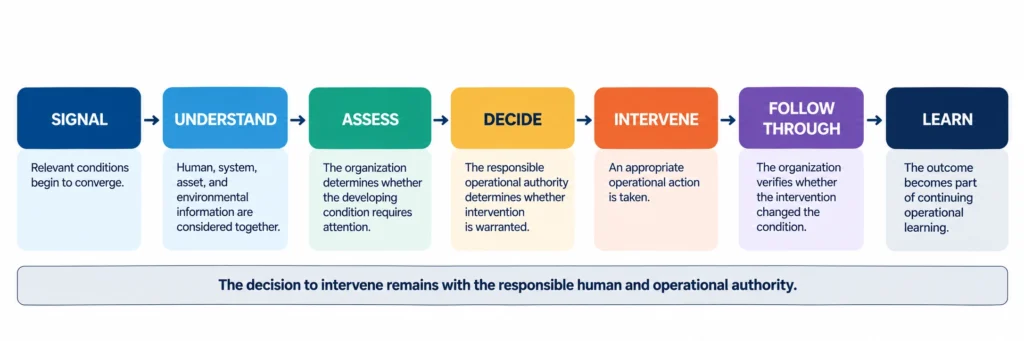
Applied Operational Logic
Illustrative — derived from the investigation evidence, not a historical reconstruction.
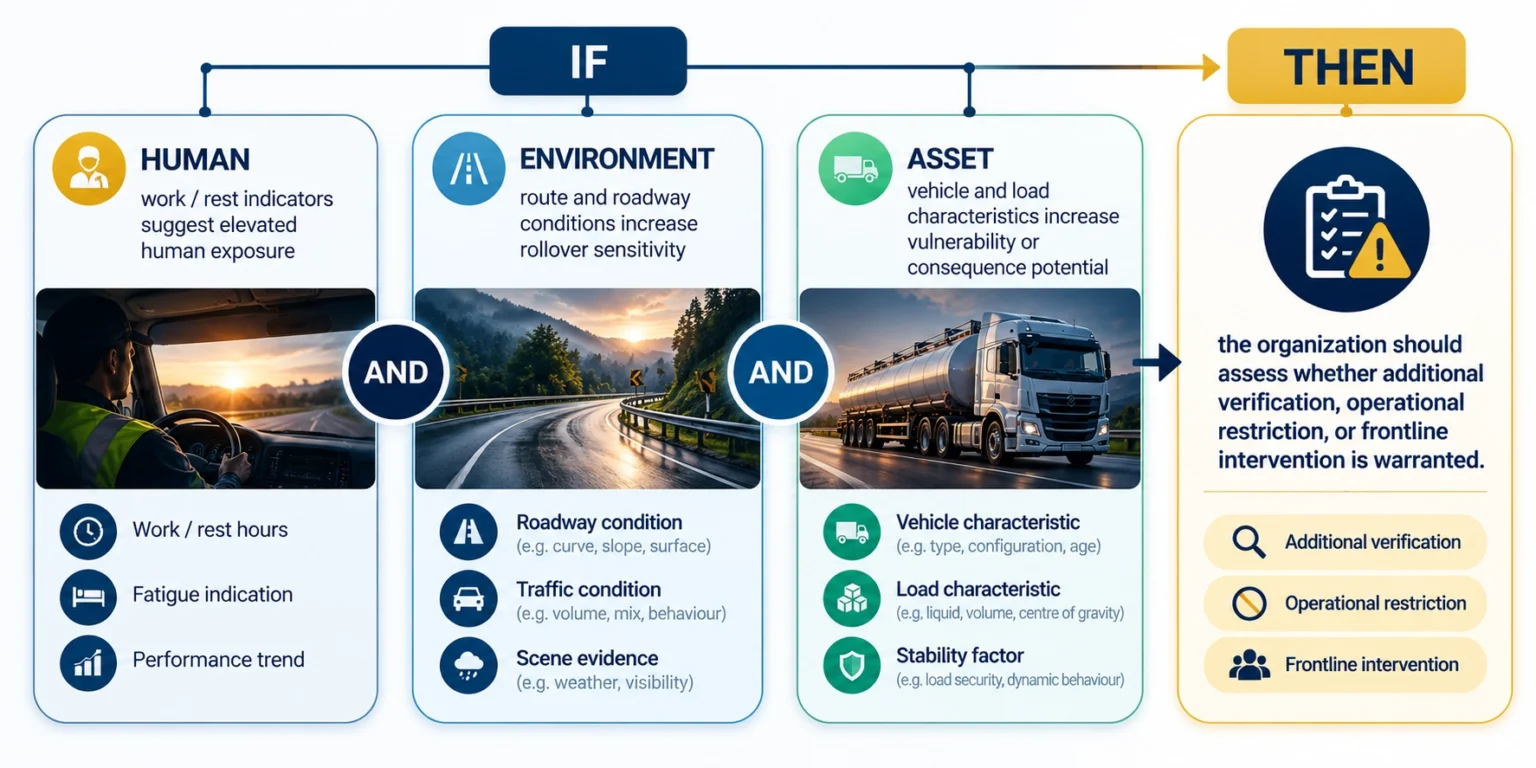
The logic is not the intervention.
It is a structured way to connect relevant conditions so that responsible people can determine whether action is required.
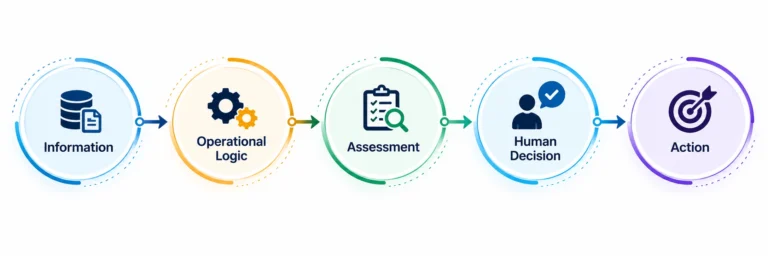
From Information to Operational Intelligence
Operational information becomes more useful when its relationships can be understood.
HSA™ does not replace operational judgment.
It helps make relationships between operational conditions more visible so that responsible people can make informed decisions.
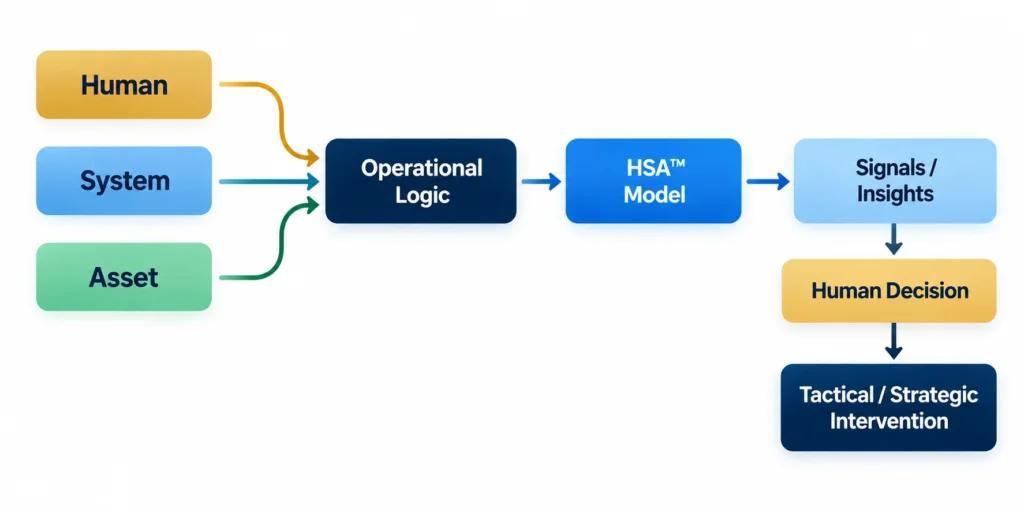
What an Applied Scenario Could Look Like
Illustrative - Not a Historical Reconstruction